
Doug Allan
Family name: Allan
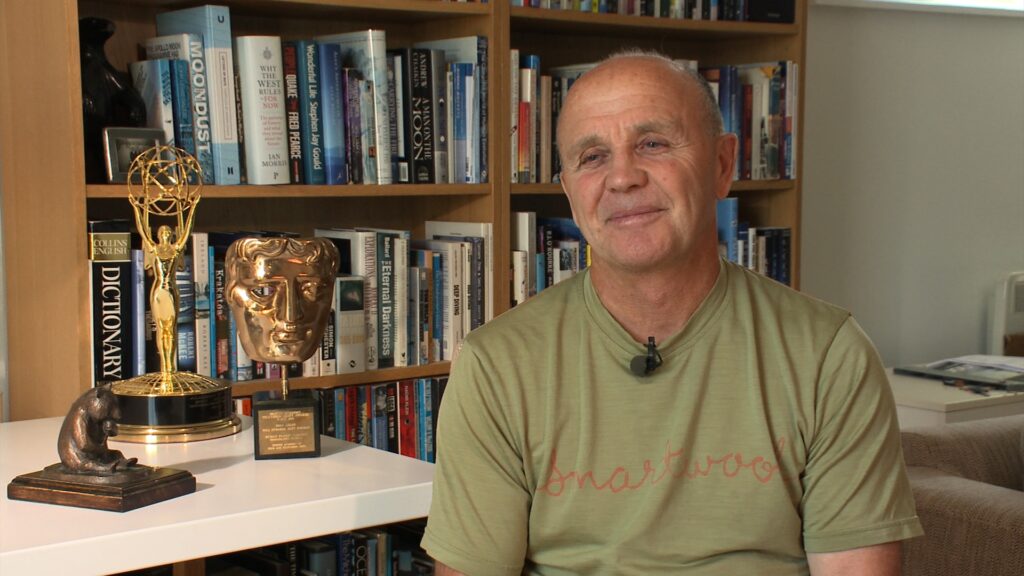
Awards/Honours: BAFTA Cinematography (1993, 1997, 2002, 2011), Emmy Cinematography (1995, 2001, 2007, 2010)
Work area/Craft/Role: Underwater photographer, Wildlife Cameraman
Industry: Film, TV
Websites: Doug Allan Website, IMdB, Wikipedia
Interview date(s): 31 August 2015
Interviewer(s): Martin Spence, Nick Gilbey
Production Media: video
Duration (mins): 68
Martin Spence 0:00
This is a BECTU history project interview with Doug Alan, wildlife cameraman. The interviewer is Martin Spence. The interview is being carried out at Doug's flat in Bristol, and it is the 28th of September, 2015 so is that all coming through? Okay, great. Okay, we can make a start. Doug, just for the record, could you just say when and where you were born and let us know your nationality.
Doug Allan 0:33
I was born in Dunfermline in Scotland on the 17th of July, 1951 and I now live with the enemy here in Bristol. What else did you want to hear?
Martin Spence 0:43
Well, I think you've answered these. So your nationality is, you're Scots .
Doug Allan 0:43
Yeah, I'm Scots.
Martin Spence 0:43
Yes, yeah. Fine, great. Just following on from that sort of in terms of family background, did your father or your mother's work or career or interests in any way lead into your own career as a wildlife filmmaker, cameraman.
Doug Allan 1:07
It's interesting, my father was a very successful freelance photographer, mostly news journalism, but not just stills photography, then moved later on into Movie photography, and he worked as a freelance for BBC Scotland, particularly doing their equivalent of match of the day, but way back when it was shot in black and white film and stuff like that. So I remember accompanying my father on a few of his shoots, but also being aware as I grew up that he had a really interesting collection of friends. He was well known. He would get the nod when it was a breaking news story, whether it was from the police or the fire or he was also friendly, and did a lot of filming photography with Denham film and athletic when jock Steen was the manager, and I remember jock coming around to the house. So basically, I was aware of this job that he did that took him to interesting places and and seemed to mix with an interesting bunch of people. And I think there was something about hesitate to use the word glamour, but there was something attractive and off, beaten off the wall about it. And so I think that, and the fact that I was a twin as well, made me very much want to make my own identity, particularly after leaving school and to do things, and I think I sought out things that were different. And so wildlife filming, I sort of fell into that by mistake. But what makes a good wildlife filmmaker? I think the seeds of it can almost be born in your childhood. You know, you have to like going outside. You have to have a kind of taste for adventure. You want to be a little bit not not show off, but you want to have something produce, something which a bigger audience sees. You need to be a bit of a showman. You know, in these days where we may be the subject of a film, I think that can count even more. So I think all these things get laid down when you're a child. And my father was bit of an extrovert, and as I say, he he enjoyed, I think the fact he was well known within Fife, and I think some of that rubbed off on me. Okay, well, we ll come back.
Martin Spence 3:17
We ll come back. Some of those themes. Can I take you back to your own education, though, because in terms of, you know, finding something unusual to carve out your identity, marine biology was your subject at university. So why? Why that?
Doug Allan 3:33
My kind of formative Well, I was a teenager, you know, through the 60s, and I remember well into reading. And some of the things I read were things like the silent world by Jacques Cousteau, the Contiki adventure, by torhadol. And diving was the first thing I got into. It was, it was, it was, there was something attracted me about it. It was the adventure element back in those days, because diving was much less accessible as a sport than it is now. So I got into diving, really. We were lucky enough to go on holiday in the Mediterranean when I was only about 10 or 11, and so a chance to snortle in warm waters, etc. And so I got into diving when or scuba snorkelling, then scuba diving when I was at school. And I also got into biology. It's funny, but biology was a bit of a Cinderella science. Back in those days, it wasn't all the really bright boys used to go in for chemistry, physics, maths. Well, there was less chemistry, physics and maths in biology than there was in any other so any other, any of the other sciences. But at the same time, biology, you know, was linked to the sea, and ecology was coming through this idea of the big picture of things. So let's just, let's not just look at how animals work in terms of their blood and their cellular structure, or let's look at how they work in the big systems. And oceanography was just coming on, and the oceans were just this wonderful frontier. We had space. Case, which you couldn't get into, but the oceans were there, and Cousteau was on the box, a whole lot of things. So that was what took me towards marine biology. Photography wasn't even on the on the radar. And as I did my degree, I realised I didn't want to be a scientist, but I did want to keep on dying thing. So when I graduated, I looked around for expeditions to work on, and worked on several expeditions in the Red Sea, ran a dive school in Jersey. Still, diving was my main interest. Got a little bit into underwater photography in the Red Sea, but then I was offered this job in the Antarctic, and that was where photography got hold. Because when I went to the Antarctic as a diver, as a research diver, in charge of the diving on a programme on a base there, that was when I really discovered photography. I went down with fairly simple photographic equipment, but when I saw how exciting it was, we had our own dark room, we could produce our own slides. My second contract going down there, I came back to UK. In the meantime, went and worked as a diver, a commercial driver in Germany, earned enough money to buy some good nick on F twos and headed down to the Antarctic with the neck on and housing. And really got into some good underwater photography. And I was really on the way to becoming thinking about Stokes photography. I was writing some stuff articles, and they were going down well. And then I met David Attenborough, and everything changed
Martin Spence 6:24
Just going back one step. Did did Antarctica come looking for you? Or were you? Did you want to go to Antarctica? Were you looking for a way to get down?
Doug Allan 1 6:34
No, I I had no knowledge of Antarctica until I read an article in a dive magazine by a diving officer who had been in the Antarctic and I thought that sounds an interesting job, so I wrote to a British Antarctic Survey who told me about the job. Sent me an application form, and I filled it in, and then promptly failed the interview. It was great. I think I went there, and I think what threw me was that they wanted a two and a half year contract, and I had been thinking it was a one and a half years, and I looked a little bit nonplussed when they suddenly doubled the length of time I was going to be away. But I think also they had slight misgivings, because me with my biology degree, I was actually going to be with standard of degree that I had, I was actually better qualified than some of the scientists that I would be working for, and they'd never had a case like this. They'd never had a diving officer who also had a degree in marine biology. And I think they were a wee bit leery about, is this guy going to take on? Okay? So they chose someone else. But then four months later, when I was in the Red Sea, I had a telegram saying, unexpected vacancy in the Antarctic. Would you like to go south? So I decided in the Red Sea that I was going to the Antarctic.
Martin Spence 7:50
Okay, David Attenborough, as I understand it. The crucial sort of connection was that he came down. You met him, but also you actually had this you'd done some footage with Emperor penguins, or am I getting the story wrong?
Doug Allan 8:05
But what happened, what turned me into wildlife filming, was a purely chance encounter with David Attenborough. Ned Kelly, Hugh Maynard and Dicky bird. So that's David. Hugh was the cameraman, Ned the producer, Dickie, the sound man, they were in the Antarctic in 1981 on HMS endurance. They were filming for living planet. And they we didn't even know they were down there, but they radioed our base one day and said, Can we come to your base, because we'd like to do some scenics and we'd like to film ice fish under water. Do you think you could catch some for us? So he said, Yeah, sure, come on along. So one morning, a week later, helicopter arrives, down comes David. I have a picture of myself the day I met David, because everybody gave me their cameras to take a picture of them with David. So I've got about seven cameras around my neck. My hair is down to about here, and I've got a beard on. And I don't know if you could ever attempt by how you looked to create the wrong impression it was probably that day. But anyway, David and I, the dive store, had big amount of space, so it became their centre of operations. And they were only there for two days. But in those two days, I drove them to different parts of the island on the boats. I took them to places because I was probably one of the better photographers on base, so I had an eye for where are the best places for views of this fusillade. So I worked with them closely, and I also took the cameraman underwater. Now, Hugh was a great cameraman, but he hadn't done that much in the cold, and we were diving with wet suits back in those days, so I had to fit poor old Hugh with the best fitting wet suit that I could and take him into the water, and we did something with these ice fish that we'd caught. But I remember even then thinking, you know, you guys are here in the summer now, I had just spent two winters in the Antarctic. And I thought, if you really want to come and see the real glory of the Antarctic, get under the ice in the winter. And basically, I talked to them about how the business worked, etc. And David and the others were really generous, and not at all holding back the information. They were very magnanimous. And they said, Look, you know, the business works like this. It's all freelancers. You knowing what you know about the Antarctic that's a good, valuable specialist skill to have. And, you know, I think that you know, think about it. So, um, they went away, and I kind of thought about it. And so when I came back to the to UK, which was in about August or so, 81 I began to think, How can I begin to get into film making? But then I was offered a contract by the British Antarctic Survey to go to another base, completely a base where there was no diving, no biology, but I was to be base commander on this station, and 12 miles from the station it was a colony of Emperor penguins. So I'd always wanted to winter at the space, because it was a long way south. Was real. It was it was the real Antarctic, let's see. So I decided to take up that job, which was a 15 month contract, but I decided to buy myself a 16 millimetre camera before I went down and do some filming of the emperors. So I gave Ned Kelly a call, and the producer and I said, Ned, I'm going down there. Are you interested in neighbour penguins? He said, Well, by the time you get back, our series will have transmitted. However, I will spread your word around, as I'm sure there's series kicking off. So my letter fell into the hands of Jeffrey Boswell, who was just kicking off a series called birds for all seasons, and he wanted, he was interested in emperor penguins. So Jeffrey gave me 10 Rules film, that's 100 minutes of film. And said, Okay, I'd like you to get this, this, this, this, this. So I went down, and I completely balls that up. Fine enough, because I had Jeffrey's film, and I had my own film, and I just kind of lumped them all together and just shot the hell out of everything. So when the time came at the end for Jeffrey wanting his 10 roles back, I couldn't separate them from all my stuff. Now, Jeffrey could have been really difficult. He could have said, right, you know, I want to look at it all. I'm going to take, you know, my 100 minutes worth, but he was great. He said, Look, I'll tell you what do you're going to pay to process all your footage? Let's treat it all like yours. Give me 10 rolls of film back. Then I will look at everything you've shot. I will decide what I want, and I'll pay you so much a minute to use it. And so all that copyright stayed with me. Jeffrey chose to use 11 minutes. Paid about 500 for it, and that neatly paid for all my film stocks. And that was what kind of launched me into it. He then also been a stroke of luck, but he wanted other things shot in the Antarctic, and he gave me this list, and he said, Look, can you tell me where and when I should go to the Antarctic to film all these birds. And I just took one look at it, and I knew that he would get almost all of these birds by going back to this one place, not the emperor penguin site, but where I had been for the previous winters. So I said, Well, look, you can go to Sydney Island, and you'll get all these things, blue eyed shags, but your problem is you're gonna have to be there for four months because you want early season behaviour with the penguins and you want empty rookeries at the end. So you said, Well, you know my other my main cameraman who's working on this series, Mike Richards, I can't spare him for that amount of time. I also can't afford him for that amount of time. But are you willing, at a much lowly rate to go down and film this. So he offered me a pretty low rate, I have to say. But I recognised if I did that, along with the emperor penguin material, plus what he shot when that series came out, almost half of the first programme would be mine, and I knew how valuable it was to point to stuff that you'd done. So that was what I did. And when that series finally came out, which was about the middle of 85 something like six, I was that position be where I wanted to be, you know, cold stuff, little bit of underwater, knowledgeable about the Antarctic. And that that launched the thing, really.
Martin Spence 14:20
And what sort of learning curve were you on at that point? I mean, was it a question that the biology and the wildlife stuff? You knew that, but you were learning the camera skills, or learning a bit of both, or what? Because, I mean, you've been, you've done stills photography, but moving picture photography is, is a different
Doug Allan 14:39
the learning curve. The learning curve is, was all to do with with filming. It was like that. It was vertical, and because stills photography is all about pressing the trigger at one second, movie is about lots of different shots, putting it together. And I recognised, first of all, after coming back with the Emperor Pinewood material and sitting with it with Jeffrey, how. Roy, my technique was in places. I improved a lot when I then went down and filmed the rest of the stuff for him. But it's been improving all the time. And it is all about I believe that the best, if you want to become a camera person, make friends with an editor, that because he or she is the person who really produces the magic, and he or she, if you ask them to be ruthlessly honest, they will turn you into better camera person, because they know just the sort of things that they're looking for. The cutaways, they don't cut too soon after the action. Just hold it, give me something I can come out, etc, etc. And so all my photography, both stills and movie has been entirely self taught, and I taught myself em most about movies by I was friendly with OSF Oxford, scientific films. They handled. They were agents for my stills photographs. So when I wanted to really learn how to be a movie cameraman. I went to OSF, and I sat down, I knew Sean Lois. And I said, Sean, can I get some of your prints out? Because he had prints of all the films he had made. And we put them there on a steam neck the old visual analogue editing machine. And I would roll the shots back and forward and make notes of whole films. I have shot lists of whole films, listing close up cuts to so and so cuts. And by analysing in that way, I could see how the shots went together. So what? And, you know, I do the same now, and it's, it's fascinating because, you know, I don't just do wildlife. People have me pinned down as well like But ever since I started, I've done tiny little bits of drama, but certainly expedition films, travel films, underwater, topside, sometimes with people involved, presenter led, etc. And you need to put a different hat on for all of those. And I find it fascinating to put those different hats on and tune into different ways you need to film,
Martin Spence 16:58
okay, but with with your wildlife hat on. Are there any I just wonder if there's a particular story or incident you can remember where your knowledge of the animals you were filming and of their behaviour, or their likely behaviour was, was sort of gave you a particular insight as to how to set up a shot or a sequence.
Doug Allan 17:22
Well, there's you build on experience all the time. My speciality was cold places. So I knew right from the start what kind of clothing to wear. And then as the shots got a bit more extreme, what to look at in terms of preparing the equipment, things like that. And then, of course, when you're in the field, the more you work with one particular animal, the more you concentrate on it, the more you can begin to predict what they might do first. But there is one shot in em, which is in an emperor penguin sequence for Blue Planet, where we have a shot of a leopard seal coming out onto the ice, chasing a penguin round. It almost looks like it's going to take it and it goes into the water. Now I would never have got that if the one of the first times we were out on the ice edge, I was standing on the ice, is looking left and right for leopard seals, and suddenly, completely unannounced, one came out on this piece of ice, came up, looked around and slid back into the water. And I thought, you know, I'll bet that seal knows that piece of ice, and it's gone up there for a reason. So every time I went out, moved, I spent a lot of time on the ice age. Every time I went out and nothing was happening, I would turn the camera around and frame it up on that piece of ice with the right zoom on into slow motion and pre focused everything. And about two days later, bump up. It came and just had time to hit the trigger, fall it around into the water. Now that shot lasts, I think, seven and a half seconds on the screen. It's running at 75 frames a second. So in other words, it was all over two and a half seconds. If I hadn't been anticipating that shot, there's no way you could swing around, find it focus with et cetera. And when I got that was on film, so I didn't know until I got back to UK and actually got it. But moments like that are just magic. And why my filming is about predicting. Because when you're sitting in a blind for 789, hours, what have you, you can't stay totally fired up all the time, but there's a way to be tuned into your environment such that you can be at a kind of lower level of concentration, but something changes to give you that fleeting bit of warning. Or maybe the animal is down on the nest, and you want to get it taking off on its foraging flight, so you sit and watch it with an eye, but you can, but quite often, they ll do something for 30 seconds before they prepare to fly off, and it's been ready for those for those minutes. And that only comes from spending lots of time with the animal.
Martin Spence 19:57
Can we talk a bit about you you've mentioned it about, you know, the. Extreme environments that you've worked in. David Attenborough described you as the toughest in the business. Okay, so, okay, I've got to ask you. I mean, what has been, has there been a particularly dangerous or spooky moment in these dangerous situations into which you constantly put yourself.
Doug Allan 20:23
David did me the great pleasure of referring to me as tough as the business. I think I'll get that on my gravestone across the top. I like to think you know danger, discomfort. There's no doubt that if you're up high on Everest or diving under the ice, or even just working on sea ice, those are those have their own inbuilt dangers, and they're probably not as dangerous as driving. I think it was the Nairobi to Mombasa Road, which was the most killer road, you know, in Africa, and driving at night is much more dangerous than any of those things. I think it comes down to experience. Comes down to those who are round about you, because sometimes, if there are good people round about you, then you just let them make the decisions. Experience counts for a lot. You know, there are things that we all do, as well as filmmakers, which are potentially dangerous, but our experience lets us treat them more with more equanimity than others. It can be sometimes about reading the animal. An animal can change its behaviour and can changes from being happy to have you around to being bored or positively wanting you to run away. So you have to recognise those sort of things. But partly, it comes back to this idea of, you know, analogue adventure, so to speak. I, you know, I do like being physically challenged, and I do like going to challenging places, whether it's in the Andes up high, or in the desert, or dealing with the cold things like that. I enjoy taking them on, but then having the experience to prepare for them properly and to make them as comfortable as you can. And to some ideas people have held some idea. Some ideas people have held would be, you know, let's live in a cabin three metres by three metres for five weeks. And, you know, take minus 30 degrees Cine and go out there every day looking for polar bears. That's my idea of heaven, you know, with one other person and no sew machines, and the production office is all those miles away. That's just great for me. There'd be some ideas people wouldn't like that so, but yeah, there's adrenaline and again, you know, I'll be honest, it's a little bit glamorous, you know, I would rather work on polar bears than pygmy shrews. You know, they both take different kinds of skill to produce a story about them. My skills lie with getting out there into the wild, but I have every admiration for every other kind of thing that gets I love Underwater. Underwater produces its own special sets of challenges. But the great thing about underwater is you got to get close to your subject. You can't hide in the water from your subject. So and 100 foot visibility, it was, would be 150 foot visibility. It's considered crystal clear on the water. Well, imagine going out your tent in the morning in the African savanna, and you can only see 50 metres. You think, Well, back to bed till it lifts, you know. And imagine if all your animals could fly because that they can do in the water. They can flicker the tail, and they're further away than you can see. They're not rooted to the surface. And imagine that there's a kind of low grade, gentle earthquake going on all the time. Well, that's a calm day at sea. Imagine it where the slightest contact with that environment and your equipment, and that's it fucked. You know, you're basically filming every day in concentrated sulfuric acid. That's what sea water will do to your equipment. So it's great to have to be able to slip in on the water top scene and work the two, and to be able to go to places where you know that you can read the snow and ice conditions and the cold and still come back with pictures. That's good fun.
Martin Spence 24:08
In terms of the diving, though, is it? I mean, you've talked about adrenaline, you know, and liking the challenge, but it sounds like it's also a question of of not simply putting yourself out there and hoping for the best, that it's a question of managing your encounter with that environment so that actually it's, it's a controlled environment is, well, am I getting that right? Well, you know, I mean, I mean, or you've got a degree of control in how you've you're not just at risk and hoping for the best.
Doug Allan 24:39
No, you, you're behind every shoot, there's a huge team that's made the decision to go after that particular thing. When to go at what sort of support you need. Health and safety can be sometimes the bane of your life. But there's no doubt that now there's a lot of and a lot of consideration. Goes into preparing beforehand, what would happen if so you've got your evacuation procedures sorted out, you've got your medical kit there, as far as you can do. None of that will ever eliminate the possibility of risk, but it is more looked at and considered, so to speak. And I think that's a good thing. But ultimately, the end of the day, you're working with nature, you're working with weather, you're working with unpredictable animals. Your experience can help you a lot, but there will be times when you know things are difficult. I've drifted away on sea ice, I think four times, which is embarrassing. I've been working out on sea ice, which then has broken up unpredictably for different reasons, and I've been stuck on a piece of drifting ice. Once I was rescued by a helicopter. Once I was rescued by a fixed wing plane. We were on a piece of ice big enough to not have to come down on no sorry, twice by helicopter, once by plane and once the piece of ice. We managed to cross the opening gap with them by ferrying things across on the ice, and all of them were the last one particular was mostly dependent on the people we were with that was up in Greenland filming for our human planet. We got stuck on a big piece of drifting ice and but the guys got us off safely. So things like that. I was grabbed by a walrus on one occasion where I was snorkelling in the water. I've just finished taking some pictures of diving guillemots, and this walrus came up from underneath, grabbed me and could have taken me down. I hit it on the head with the camera, but and it let me go. But if I had held on, then I would have drowned, undoubtedly, because snorkelling, you know, and basically it mistook me for a seal. That's how the attack seals in the water. Now, hard to predict that kind of thing. No one had seen the walrus around, etc, etc, and I wasn't looking ahead of me for it. I think if I had seen the walrus, it probably would have been enough for it not to attack. It was very much relying on surprise. So you need to be canny, and sometimes you need to be a wee bit lucky.
Martin Spence 27:12
And from those, the floating off on a bit of sea ice stories, the image that maybe I have is actually that a lot of the time you're out there by yourself, but actually you're always out there with a team.
Doug Allan 27:26
There are almost always, yeah, I mean, one of my most satisfying shoots was when I did the Denham the polar bears coming at the den for planet Earth. That was the smallest possibility that was just myself and Jason. My fixer, Jason's immensely experienced guy, working both with polar bears and in the cold. And we got special dispensation to go and live on this area called Concord land, which was a protected area. And we were the first camera crew to ever be allowed to go there. And because it's a protected area, they stipulated one trip in, one trip out, only two people, and no snow machines. So you gotta take everything you need for your five week shoot in on the helicopter. We will rescue people if there's an emergency, but we'll take both of you out. We won't replace people. We won't replace supplies, replace but that was a really that was fantastically satisfying. Shoot. Couldn't get any simpler than that. And it goes all the way from well now, if you if you're doing a marine shoot, say, with helicopter sportless Cine flex or something like that, you know, you might be pretty complicated, big teams, things like that. And even nowadays, when you're working with Cine flexes, or gyms or what have you. You know the numbers, the team numbers, tend to have gone up slightly, and because of the cinema, feel that they want to give to these big productions. Now they do get more complicated.
Martin Spence 28:55
We'll come on to that. Is there a single in your terms, in your personal terms, is there a single programme or sequence that you filmed that that gives you a special pride?
Doug Allan 29:10
I've been I mean, I've been lucky. I i The phrase I use is, when I started working in the Arctic and the Antarctic, it was like, I'm in Africa to myself, they were so little exploited photographically before then, we had great films like kingdom of the iceberg from Hugh miles, but that just scratched the surface, in a way, and I got this run of one programme after another, which mopped up all these great things. So it's hard for me to pick a single sequence, but I guess I'd pick two. I think the first leopard seal sequence, leopard seals predating a daily penguins, which we shot for life in the freezer. Now that was a lot of people on that shoot. Alistair banked a lot on it. And the way things worked out, because of the dates and because of what other people were doing, we had about four camera men on that shoot, two of us under water, covering. That side of it, and two on the surface. But because of it, that seven minute sequence of the adalia's is a little masterpiece. All the shots are there. You build up the tension. You have a bit of a laugh when they slide on the ice. The leopard seal just appears as a head first of all. Come on Goon down. Really beautifully put together, and it tells the true story. So I would choose that one. Then I also choose the polar bear swimming, which was out of polar bear special, which I did about seven or eight years later. We Martha Holmes and I, we went, we were planning to get the polar bear swimming underwater, and we ended up with this wonderful again, it's about seven minute sequence of a polar bear swimming underwater. And I think there's one stretch of about four and a half minutes where there is no commentary, only music, and yet it totally carries. We had a we're lucky enough to get a wonderfully lucky, not persistent enough to get a wonderfully calm polar bear, which allowed us to approach closely in the boat. I started off by being in the water, hoping that they would swim over my head, or I would somehow get close to them. Well, that was a little bit hairy, really, because, you know, they attack seals in the water and and it was hard to concentrate when you couldn't quite see it, expecting a paw on your shoulder at any moment. And but the thing I realised from that was that a polar bear swimming languidly through the water, you can't keep up with it. It swims far faster than I could. So therefore you weren't going to get these the best shots. But what we did find was a polar bear. Eventually, of a polar bear, we could approach this polar bear from the side with the boat, and eventually I was sitting in the bows of the boat, a little camera on the end of a pole, and the bear was just down there. Martha was looking in the monitor. But we could put this camera, we could get ahead for the wides, we could put it right between its paws. And it was a flat, calm day. And so we got this lovely sequence of shots of polar bear reflected itself above. And this polar bear just swam, paddled, popped its head up, swam through the ice flows and all the rest of it. And it's a it's just a peachy sequence, and every time I play it presentations, everyone is blown away by it's not that well known because, funny enough, polio special. I don't know if it's available as a download you can buy, but it's a good sequence to have because no one expects it. So I would say those two stand out in my mind, but I've been lucky and filmed several old things for the first time, polar bears hunting belugas, grey whales being hunted by orcas. You know, several other things. The leopard seal was done properly by sarahson. So I've been very rich, but, you know, I'm still getting new things. That's the great thing. Just last month, I did film for Brian Cox that took me to a part of Iceland that showed me something underwater I'd never dreamed about.
Martin Spence 32:46
What's interesting in both those sequences, they're both team works, aren't
Doug Allan 32:50
they both teams? Yeah, the whole thing is team efforts, you know, having said that, you know, Colin Carlos land, I mean, Jason and I were a team, and it was the producers and the guys back in Bristol who were contributory to getting the permissions to go there, etc, etc. So wildlife filming is all a teamwork. And in fact, wildlife films are all a teamwork. And you can pick out the crucial bits, you know, I have a feeling. And while the whole team is important, the three crucial players are getting the three crucial stages are getting the image down in the first place, and then getting edited, and then the producer putting the whole lot together. And when you have those three people all in song, that's when you get the the whole is greater than some of the parts. There's a bit of magic at each stage. On the other hand, if any one of those three is less than great, you won't produce a great film. You need great rushes to start it. Great anything. Great production you can spoil at any point. And I've heard them spoil, believe me.
Martin Spence 34:01
So I mean, this feels like a good time just to refer to the the awards, because, I mean, you've won a number of awards. I mean, again, rather than talk through each one, because there's quite a few three in sight is there, is there a particular one that gives you a special pleasure? And can you just tell us? Tell us what that what that referred to.
Doug Allan 34:23
I, a number of my awards are for the camera team. You know, some of the, some of the couple of the BAFTAs for the camera team on so and so. I guess it's the individual ones. You know, I want an individual EMI for, for helping with the great white shark programme that was an EMI. One of my BAFTAs is for two my BAFTAs are, one is for polar bear special. One is for the Arctic programme in in human planet. Now, both of those were even sheer because Martin, Martin Saunders was the joint camera man on the polar bear special. And. There are two others on the human planet, but, I mean, awards are, there's no doubt, they're very satisfying to get, and they're great at the time, but you have to be philosophical you want ultimately, it's a subjective decision. And I've seen some very good films get passed over for some awards. And I've seen some, in my opinion, less than the best films win the awards. It is great to be recognised by your by your peers. And a lot of these judging is done by peers. And I remember the BAFTA for for the polar special, Kevin flea who's a great cameraman. He was on the BAFTA committee, so to speak, that was awarding the cinematography prize that year. And after I got it, he came to me and he said, You have no idea how hard I had to fight to get this film recognised, because his people and others on the team had no idea what you went through, how many days it took to get that and it was only by telling them that, that they recognise this true value. And I thought, well, that's kind of simultaneously, oh, go. We must get passed over all the time. But also that's fine. You know, people, it's a it's there's something good about people not realising how much effort it takes. Somehow, there's something curiously satisfying about them. When you sit back and people think it's easy, and when you sit back and think I know how hard this was, and I think the same thing goes with anything you know, dramas, commercials, features, what have you, you shouldn't be aware of how difficult it was when you watch the finished product. Otherwise, it's not doing its best job. But these little 10 minutes at the end are good. I think they're really useful for the public. Seems to really like them and the they do give a chance for the the the unseen people to get their chance showing things. In addition
Martin Spence 36:53
to all the you know, the work you've done as a camera man, you've also always been really active in the representative organisations for wildlife filmmakers, and the iawf, and then IA WF got together with BECTU. So I mean, without going into enormous detail, what are the main issues facing the craft you know, people who are trying to make a living as wildlife filmmakers, in terms of their contracts, their terms and conditions, their rights as creative individuals. Where are we? Would you say?
Doug Allan 37:25
Where are we? Well, over the course of my career, I've always been wildlife camera men. In particular, I thought camera people, I should say, you know, are a pretty sociable bunch. Usually, they may not see each other very often, but they are a discrete group, and most of the time the camera people are pretty helpful towards each other. So we set up the International Association of wildlife filmmakers in the early 90s, more as a kind of social thing, but then we also found that in chatting at these social events that we had with certain issues that we wanted to address. And so we became a voice that tried to talk on behalf of camera people to the BBC and other employers about rates of pay, for example, was the simple thing and travel days, but then also about possible deals and things like that. Unfortunately, we didn't have a great deal of success, partly because it was we just didn't have the consistency of approach, and we weren't able to penetrate the labyrinthine structure of the BBC. We seemed to get somewhere within the Nhu. We got a lot of sympathy and a lot of ears listening to us within the Nhu. But I don't think any of us fully realise the Nhu is just a little bit of the BBC, and who's actually calling the shots. It's higher up the scale again. So we with the idea that we then approached. We got this word, got this cooperation going together, which has been much better. It's resolved several things because BECTU had the pipeline into the BBC, and they took all their concerns very seriously. And now I think there are still. I think that you, I'm not a union man through and through, but I think that you you do need some form of representation higher, you know, with employers, particularly when you're dealing with a big company as big as the BBC, which has its structures. I think what's good about BECTU is they can tell you about the BBC structures, and therefore you can understand what it's practical to ask about and what you're not going to get anywhere with. So I think that that we've sorted out rates of pay for those trying to get into the industry with travel days, rates of pay for those more experienced people who have left the upper scales open for those who want to go to which I think is completely fair. Yeah, and we see another still try to bend things slightly, and I still get people coming to me saying, I'm about to get employed by so and so, and they're offering me this, and I say, Well, you know, they shouldn't really, if they want to play as a camera person, then that's the sort of rate you want. We're always going to have an issue in wildlife filmmaking, I think, because it's perceived as a as the glamorous end of things to get into. It may be the same in other bits of the industry, but there's no point. Or I think it's a shame if you make a lot of effort to get into world life filming, and then find 10 years down the line that you're not actually making a living at it, and you have to look somewhere else, a different field of filmmaking, or something like that. I think we should have a bigger range of of them, of budgets available for colour people, so that if you get called in to use all your experience on a series which is supposed to be a landmark and is going to make them a lot of money, I think there should be higher rates of pay for those people. I think the BBC, at the moment, is struggling. We've seen an upsurge in the last few years with worldly feature films, particularly from Disney. Now those Disney films are funded. I've never worked on once. I'm not entirely sure, but let's say I think they're funded in the order of something like three and a half to $5 million per 90 minute programme. Now if you scale that back, that takes you two and a half million for an hour. Now, the BBC are paying nothing like that for an hour, and they are basically trying to get stuff which in some respects is even harder than Disney's, because Disney's tend to be Goon more dependable things. They treat them in a different way. Their money goes a lot on time in the field, but not to come up with new behaviour, but more for kind of dotting the I's and crossing the t's on a storyboard that may almost be done for them, because that's the kind of 90 minute film they want to make. So in some respects, a 60 minute film, which the highlight will be behaviour you've never seen before that needs even longer or more money, and yet the beaver still trying to do it and managing to do it on less now. There's also, I think, a crucial number of these that can be done per year.
Doug Allan 42:20
I would like to see there must be a new way of packaging wildlife. I have to say that since blue planet, they've almost all been environment based. You know, you have a series, right? Let's look at the oceans, deserts. You know, blue planet did that for the oceans. Planet Earth did that for the whole oceans. Then we had life which basically divided down the species and looked at them in different places. We've got a thing called one planet, which is in production just now, which, again, is environmentally based. We have Alastair make it. We had Alistair making this new one Netflix called our planet, which again, environment based. I wish there was a new we've got ocean series from BBC, but again, that's environment based. Just look at different environments within the sea. I wish there was a new way of packaging it, but it's now a more globalised market than ever. We have to remember that some of these things are being you know, the big selling markets may be well away from America, or even, you know, in Europe, they're pushing towards China, et cetera, where a whole raft of people have seen nothing like this before. So therefore we can't afford to revisit these places again, but I can't help but think it would be nice to do something a bit different. On the other hand, these big series keep producing lots of money and keep delivering three, four or five times their profit over the what they were made. They deliver lots of valuable for trims. They keep being made on the very latest formats. The Future Proof them as much as possible, so I can see entirely the commercial reasons why you would do them. I would just like to see a bit more imagine, more adventurous imagination in what we tried. I think there's, there's still a woeful under selling, or under under the commissioners still are dumbing down for the audience. I don't think, I think the audience could take and would absorb a higher level of information in the programmes presented in a different way, for example, to date, this interview, but oceans wouldn't be nice. Instead of doing the oceans, coral reefs, deep ocean, open ocean, etc, why not take six currents that would take you around the global conveyor system? You could choose a current that mostly that head through the Caribbean, and do that would deal with your coral. Oops, take another one that takes you to the Arctic and the Antarctic. Take a deep water Currently you can deal with the deep take them that way and give the, you know, give a more ecological view of the whole thing. And introduce a new concept to people, this global conveyor and everything's in the interaction with the atmosphere. You could pull in bits of climate change, things like that. I'm very well aware that the minute that you put people into a series to an extent, or a conservation story into a series, you give that series a sell by date, because projects move on, they drop out of fashion, they get improved, etc. So whereas a pure blue chip thing that can technically last forever, except when you've got no environments left, then you've got a very valuable bit of archive, because the animal doesn't our place doesn't exist anymore. But surely, if there's a danger of that, and there is a danger of that, we should be making more films that address that issue, and there must be a way, you know, I think of particularly the BBC, which has a public remit. After all, you would think that they would be thinking, Come on, we need to get into these issues. That is our job. It may not make us as much money. It may be watched by far fewer people, but we have a we have, you know, that is part of our remit is to deal with publicly important issues. And so it'd be nice to see a series come up, or to see them dedicate more time to that kind
Martin Spence 46:21
of thing. So, I mean, to put it in shorthand, what you seem to be saying is there's a danger, maybe, of the glamour, you know, the visual glamour of this particular subject area, slightly trumping the scientific integrity and the educational role. Is that?
Doug Allan 46:37
Right? I think that, no, I think that the films we make are full of scientific integrity and full of good intent. But I think the if we're putting all that effort into it, we should be putting effort into a series which is a bit more powerful and a bit more important, that may not be as long lasting, but it needs to move. The one that I always think is interesting is, for example, Hugh Fairleigh, whitting stalls, fish fight, for example, which changed EU law. Now the beep should be doing things that other people should be doing things like that. There's a whole number of issues. It's disappointing at this stage in time that the BBC isn't doing more climate change films with this big cop thing coming up in December. I don't see anything on it. I would have hoped for a climate change season where you get the sceptics together for a big debate, where you have a number of programmes that set them up. They don't have to take sides. Or if you do have one taking sides, you can give the other people sides, but just something to inform the public more all about this sort of stuff. So, you know, I'd like to see that. I think that, just to go back and add this bit, I think that the BECTU relationship with camera people is really important. I think camera people should join back to partly because it's an organisation we're worth supporting. Simply, you know, the public liability insurance you get a loan will sort you out and that that comes up in an awful lot of situations. But I think, you know, there comes a time when you want to use their experience to either about some legal issue over a contract or or to resolve some issue, to know what the official position ends. And I think for those reasons alone, as well as being a member of it. And, you know, hopefully it's a little bit like an insurance policy. You hope you'll never have to use it, but the premium that you pay will, you know, see you fine. Should the worst case scenario happen? And I think they always are. They're always there behind the scenes and and, you know, I have people saying they are, they don't do anything, blah, blah, blah. And I think that's not right. That's not true. They do do a lot of things. It's just the end, they do them so quietly and just get on with it that you're not aware of of it being done on your behalf.
Martin Spence 49:03
I'm not gonna argue with any of that. That's good given all this. I mean that and what you've been saying about the way the industry is going, any particular advice you've got for young people who have ambitions to work in this area?
Doug Allan 49:18
There are a lot of young people trying to get into this business, mostly, I think, through the appearance of these 10 Minute diary pieces at the end, when I started, there was none of that, and you could make your way in. Now there are many, many graduates coming through who even specialise in wildlife filming and photography. Now I don't know whether they ll all get a job, and LL all end up holding the rates down. And 90% of them, in 10 years time, will have to give it up because they can't make a living out of it, if that's Darwinian evolution of what happens. Fair enough, I personally of opinion that you could take a. Lot of these three year courses and teach someone to be a camera person in six months. Now, whether we see that happening and you never stop learning, there's a lot more to the technicalities of it than there used to be. My advice to people who want to break into it is perhaps hold the dream or the intention of being a specialist wildlife camera person, but to start with, do anything and everything, because you ll need to do anything and everything to survive. And to some extent, that s what I have done all my way through my career. I have done bits and pieces of other things which never make the headlines, so to speak, as much as 10 minutes in the end of a big programme. But they've all been fall backs when, when wildlife has not, you know, the jobs haven't been coming in there. I've been able to go to another production company and see, hey, have you got anything this kind of thing? I'm a great believer in cross genre. I think that you can, if you look at a wildlife film, and I was to talk you through it, there are bits of feature films in there. There are bits of commercials in there. I think you've got to open your mind to everything that you want to do. And I think you've got to remember that you're as much as your product. You're selling yourself. People don't work with people who appear in the hours, so try to get meetings with people, but remember that they're busy, and they ll remember you more for taking up five minutes of their time than looking at their watch after half an hour and kind of ushering you in the door. And if you want a show reel, then your show reel should ideally show you can do lots of different things. And if you want to be a camera person, talk to editors. Spend time with editors.
Martin Spence 51:40
Advice. Okay, we're almost there, I think. But just in terms of your career from here on, you know, you've published your fantastic book freeze frame. You've got a speaking tour coming up later this year. We're talking in September, 2015 it's in November. Yes. Where do you see your career going? I mean, are you still actively looking for those jobs out in the Antarctic or the Arctic? You know, the diving jobs?
Doug Allan 52:11
I'm still active across the board. I've just my time now is significantly split. I do. I find it profitable and enjoyable to take six weeks out and to do a tour in theatres and libraries, stuff like that, and in that time, mix in one or two one offs. You know, I'm doing something for Whalen Dolphin Conservation Society, doing a talk for them. I'm doing several schools, what have you. But I still enjoy filming, enjoy different kinds of filming, and between April and August this year, I had seven lovely shoots. I was in the Indian Ocean working for a conservation group. I was in Canada, working for them on a film about over fishing. I was doing a sequence in Iceland for Brian Cox's programme, another sequence for that series in Newfoundland. I had a little trip to Scotland. I took a private client to the Arctic to look for polar bears. You know, it's been hugely variable. I'm just beginning to think about what I might do next year. I invested in a red so I made myself more marketable, but also so that I have a 4k camera for possibly shooting stock photography. I've got more strings to my freelance more than ever. It's made life quite complicated, and I'm still would love to do a big film about issues. I'd love to make a film about Arctic climate change. I'd love to make film about some of the big issues facing us, because that's where I find my passion now is taking me, but on the other hand, if you bring me a wildlife sequence about somewhere that I've been before, or somewhere that haven't been then I'm also up for doing that. So it's kind of plus i shows, plus I remember shows, but with bigger variety than ever before. And I'd certainly hope to be, you know, still being asked to do things in several years time. But the more you do of the talking and the different things, the more you get different offers coming into you. And that's what it's all about. And sometimes the change is as good as a rest. And so it's fine,
Martin Spence 54:18
okay, that's my lot. Anything else that's just occurred to you that you'd, I
Doug Allan 54:23
don't think so. If you, you know, you've pretty much gone through it as a Cine it's interesting, because next year I'll be 65 you know, so that I can't, I don't want to stop, and I can't really stop. I've got, I have financial goals that are, like, two and a half years beyond that, but I do have an exit, not an exit strategy, but I do have a plan that that, I think it's in 2018 so in something like July 2018 Well, at that point, I would be able to say, right, you know, I've got enough put away and enough that's kind of guaranteed to come in from Roy. And jokes, what have you that I don't really need to work so I can really pick and choose what I do, how much time I spend, what kind of different things. But you know, by that time, hopefully, you know, if you you don't need many of these ridiculously high paying corporate gigs where people want you to go and talk about motivation. You know, come talk about motivation for 45 minutes, and we'll give you a few grand. Do you think Lois they're coming in, you know, maybe I'll do, you know, a month or couple of months on an Antarctic tour ship, you know, which, again, the pay isn't great, but take the red shoot 4k get me to somebody you know. So I don't think I'll ever be too far from from images of some kind. But there might be a second book. For example, I've thought about that. There's that book to take into a downloadable form. There's there's a number of ideas that I've got, and some of them will need an extra little bit of cash. Because one thing, the reason I self published the book was because I'd seen so many great ideas for films get commissioned and then just dissolve into something that the original author didn't really want. And by the time I came to do that book, I kind of had in my mind a very strong idea of what I wanted it to sound like and look like, and I knew if I went to publisher, I would lose that control, and so I held on to it. And in the end, it was absolutely the best idea, because doing the book, the way that I did was like making your own film with an editor that you really trust and a producer that you really trust, and no no big arguments about which way to do it, lots of discussion and sometimes some quite strong words about, I think this is better than this. But in the end, everybody the best decisions were always made, and you end up with something that's that is lovely and still feels lovely. And that's why I wanted to self publish it, and that's why I'm interested in in opportunities that allow me to hold on to my footage, because I've got a little bit of my own. It's not all 4k whatever you bet, but I'm beginning to make use of that by making little films and putting them on the internet. And you're crowdsourcing as well. I'm thinking that, you know, if I go to it's not out with the bonus possibility to go to the Arctic, and with my ambition of filming a novel and crowdfund it. And I could crowdfund it by, by not paying, not paying myself anything, but paying all the transport costs, paying for a another person to come and film me and but I could probably get it by, for example, I could do some limited edition prints from the book, because I own the copyright. So I could sell those, you know, for $100 100 pounds a time, and raise money through crowd funding thing like that, you know. And it's something that I want to look into. I'm talking glibly about I'm the biggest technical Luddite that is there, but I know people who know what I can do, and I think it's really quite exciting doing that sort of thing. And so one of the biggest assets I have is the stills library that I own. And I didn't maybe realise the time I remember fighting, sometimes through the years, for holding on to the copyright of those pictures. And believe me, it's the best thing I ever did. And likewise, now I'm beginning to see the value of holding your own movie. Whether it's doesn't really matter the definition, you know, you can put it on the on the YouTube and etc, pretty you know, doesn't have to be the latest, but that's an area that I think is is really useful, but it's hard for you, for for people who are not where I am, to do that, because it's expensive to buy the equipment, self fund, yourself to go somewhere and then work on it and all this. If at the same time you're trying to make a living, you haven't you, it's hard to do the two. It's even hard to do this book tour. Not hard to just book tour, but the money that comes in from the book tour the theatres won't be up for a couple of months. In the meantime, I've got all the travel costs, etc. The book sure is cash in your hand. But don't forget that I spent 10 grand on the last print run, and I'll only make that 10 grand back as I sell the books. So it's all about cash flow, but it's a fascinating world we live in. And you know, I wish I was interested. I'll still probably be with it in a few years, too. I hope lots of ideas Great.
Martin Spence 59:31
One of the things we addressed through BECTU was the transition from shooting on film, mostly on 16 mil, to various digital formats. So I mean, how's that affected your career and your work? What are your reflections?
Doug Allan 59:47
I started back in days when everything was filmed underwater on topside. In fact, my first film, proper film that I made, I made in the Antarctic in 1987 and if you can imagine, I went on to this station. Was it was to make a film through the winter. So I arrived on base in the middle of March. Two weeks later, I had exposed a couple of rolls of film. I sent them out and back from the end of March until the ship came to pick me up in December, no way to get anything out. I shot 150 rows of film and didn't see a single frame. It nearly destroyed me, sort of, you know, all kinds of things, but that was what it was like most wildlife shoots, you were so remote that you didn't get a chance to send any rushes back. The first time you'd see them was when you'd come back and about somewhere between a week and three weeks later you get a phone call, yeah, your rushes are back. You want to come in and sit with me. And you would sit down in the viewing theatre and projected onto screen in front of you there with all the scratches, all the out of focus bits, every mistake you could possibly think of was what you had shot. And sitting there would be the producer, and quite often the editor, and you'd sit there and you'd hear and you think, is that of admiration, or how am I going to cut around that sort of thing, you know? And it was pretty nerve wracking, but it did obviously give you discipline. To some extent. It was completely different, because you just couldn't shoot willy nilly, etc. Underwater was particularly difficult on the film. The most you had roll time was 10 minutes off a 400 foot roll. If you were putting the slow motion through, then it would be it would come down. If you put film through, it 50 frames a second, obviously will last five minutes. And when you had finished that 10 or five minutes of film, there was no option under water except back to the surface, back to the boat, dry. The housing split. The housing new magazine on how to find what you'd been looking at. You know, no GPS, so the boat might be drifting, or the animal meanwhile is thrown away, what have you. And also, film just made bad conditions look even worse. One of the first things I noticed about video when I started shooting on it was how video pierced kind of murky vis it made it look sharper. And that was a big, big plus. The other plus was going away from 10 Minute loads to one hour tapes, great. The cheapness of it film, I think by the time film finished with me. It cost about 20 pounds, 25 pounds a minute to view it, so the time you bought it, processed it, made a one light print, looked at it. 20 pounds for every minute. LL tape. You could just next to nothing for a tape, and you could reuse it if you wanted to, etc, etc. Big, nice, bright view. Finders underwater were great, rather than peering in through through an optical thing,
Doug Allan 1:02:46
the one hour load was great, the ability to kind of punch up your images, etc, etc. All those were hugely advantageous for underwater, and that was why tape came in underwater. Tape came in much quicker than it did topside, because the it just produced all these advantages. Contrast wasn't often so much of a problem underwater, underwater, especially during a nice, dull day. Even today, I'd rather film underwater when it's dull than bright sunshine, because you've got a much lower contrast ratio. So again, the issue with early video was the level of contrast he could handle wasn't so much of a problem underwater. So I was lucky. I worked early on in my underwater filming career with Pete scoons, who sadly died last year. Pete was was the innovator as far as underwater film techniques were concerned, not just with film, but he totally embraced electronic when it came along. And he was right at the forefront of everything, right from Betacam, you know, Digi, beta HD, etc, all the way through. Pete was right up the front. And I was lucky enough to use some of Pete's equipment, particularly on life in the freezer. And it was just a revelation. It was just said, I never went back to tape after that. I never went back to film. Sorry, after that, and I guess it's just getting better and better. The fact that we're now dealing with digital where every copy is as good as the last one, it's pretty wonderful. On the other hand, don't let anybody tell you that, because we've gone on to download that the equipment is lighter than it used to be in the film days. Okay, so 15 rows of film was quite limiting in terms of the amount. And 15 rows of film is quite heavy, but geez, the cameras, the computers, the generators, the drives, oh, that way outweighs the heaviness. And I caused to lift my re, my Sr, out of the box not long ago. And I couldn't believe how light it was. It just popped into my hands like $1 compared to the red, which is, you know, like a dense it's like a dive. Weight used to be red, and ergonomically too, cameras seem to have slipped back, you know, Betacam, the old standard Sony Betacam, and the Panasonic that sat on your shoulder. Our hand grip here, everything on this side, they evolved for a very good reason. It was classic. You know, they were the same because they evolved. That was the best shape. I don't think there's a camera around. It sits as easily on your shoulder and is quickly convertible these days, and has everything where you want it on this side and hand grip. I haven't seen those. Maybe I'm not looking in the right places, but in terms of lightness, ease of pickup and and those two standard cameras, you could drop one and pick up the other one, and the buttons are all in the same place. Everything's just, you know, it's all changed so much now. And I think some cameras are definitely studio cameras, and other ones are, you know, better in the field, but it's interesting. Times as pros and cons, the amount of data getting is just ridiculous, you know, terabytes and terabytes in a day, and very critical about choosing big critical decisions need to get made before you before you start shooting, as to what your post production path is, and all this kind of stuff. And we still have an issue with non standard formats around the world, 16 mil used to be 16 mil, wherever you were. Now, it's anything, but every few years, something comes along that's better. A camera that I bought last year has now been not superseded, but they're looking for an 8k upgrade on the red now it's only $20,000 not so I'm just waiting for somebody to ask me for 8k and we were shooting on 4k and there's hardly any 4k television sets over so it's all gone a bit mad. And sometimes I think it's the car pull the horse, you know, we the things are designed by, not by people who eventually end user, and certainly, then there's a vast range of end users and worldly end users, didn't be well done the wrong in terms of, you know, getting the best cameras, any follow up, anything else, yeah, yeah, yeah. I mean, I wouldn't. I wouldn't like to go back to the phone days, I sometimes meet young students who say, I wish I had the chance to shoot in film. And I kind of say, well, you probably wouldn't like it. You wouldn't like the fact you had to shoot something and not see it for two weeks, and you wouldn't like the running out of film after 10 minutes.
Douglas George Allan OBE FRPS FRSGS (born 1951)[1] is a Scottish wildlife cameraman and photographer best known for his work in polar regions and underwater.
Allan is one of twin brothers born in Dunfermline in Scotland, the son of a photographer and photojournalist who ran his own photography shop in the town. As a child Allan became a keen snorkeller and underwater diver, which inspired him to study marine biology at the University of Stirling. His first job was as a pearl diver with Bill Abernathy, the last pearl hunter in Scotland. Allan then worked for eight years for the British Antarctic Survey in Antarctica as a research diver, scientist and photographer.Becoming a full time cinematographer in 1985, Allan has been a principal cameraman on many BBC wildlife programmes, particularly concerning extreme environments, including Life in the Freezer, Wildlife Special: Polar Bear, The Blue Planet, Planet Earth, and Frozen Planet.
Allan has won eight Emmys including "Outstanding Cinematography for Nonfiction Programming in 2002, for Blue Planet, and in 2007, for Planet Earth. He has won four BAFTAs and in 2017 he won an outstanding contribution award at the British Academy Scotland Awards.He frequently gives illustrated lectures and talks, including at the 2016 Cambridge University Expedition Society annual dinner.
In 2012, Allan was awarded an Honorary Fellowship of the Royal Photographic Society.
He appeared on BBC Radio 4's The Museum of Curiosity in November 2019. His hypothetical donation to this imaginary museum was "The feeling you get when a wild animal trusts you"
Images may be subject to copyright. If you are the rights holder and wish any image to be removed, please contact us and it will be taken down promptly.
Disclaimer: The views and opinions expressed by interview participants are personal and do not necessarily reflect the views of the History Project or any of its volunteers, employees or representatives. (See details). Please also see our Takedown Policy.